
 BG
BG  BY
BY  CY
CY  CZ
CZ  DE
DE  EE
EE  ES
ES  EU
EU  GR
GR  HU
HU  IS
IS  IT
IT  LT
LT  LV
LV  MY
MY  PL
PL  PT
PT  RO
RO  SK
SK  TR
TR  UA
UA Levenhuk New Skyline PLUS 80/900 EQ2 Telescope
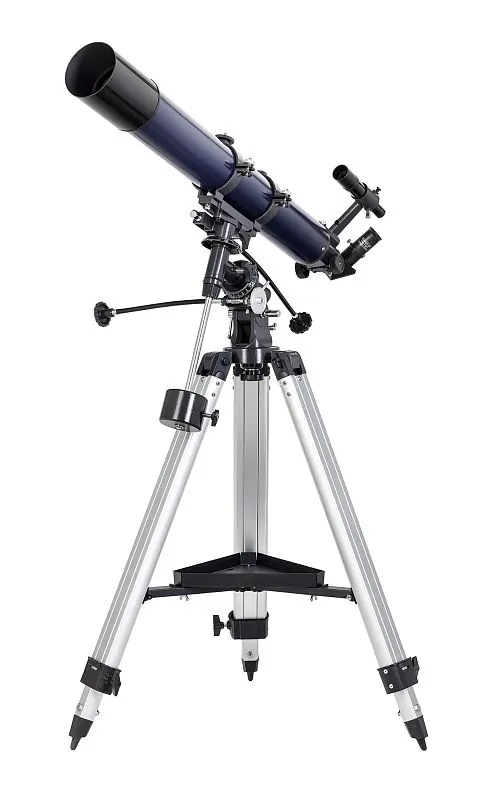
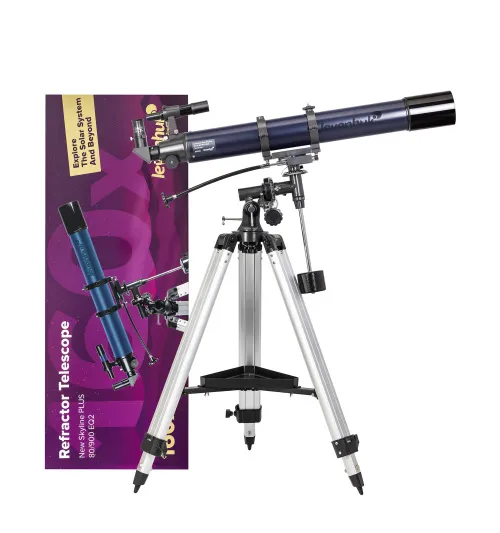
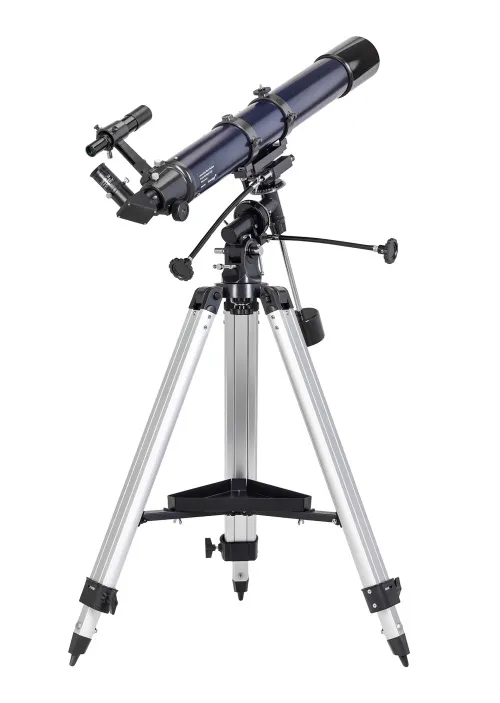
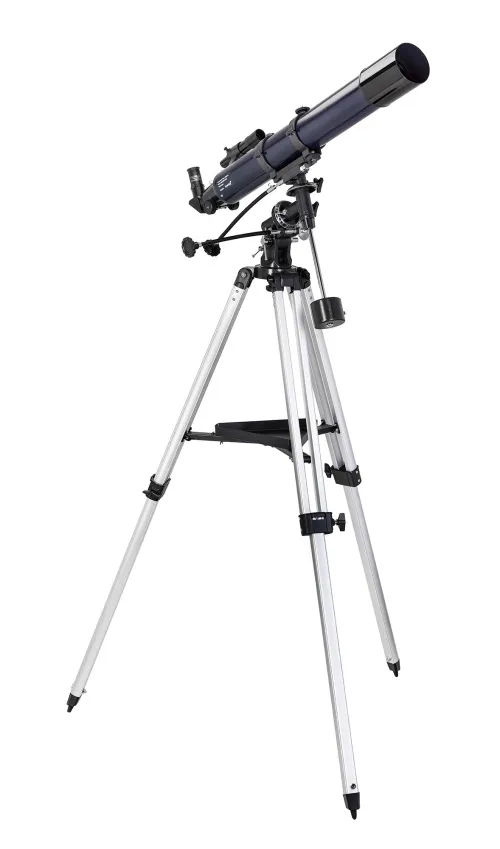
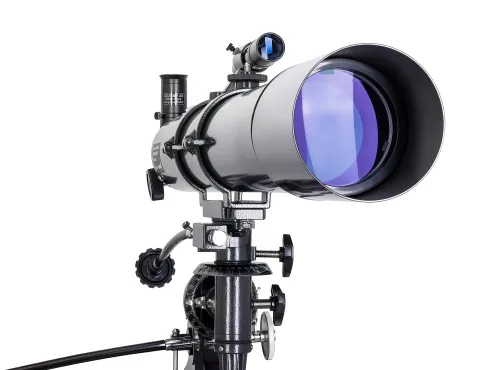
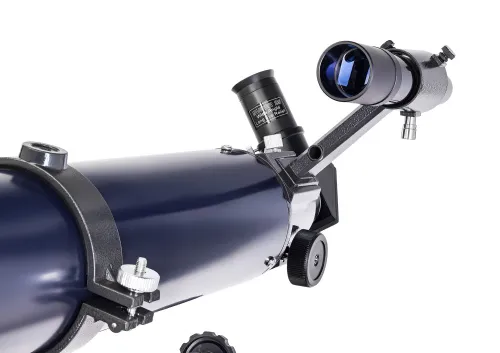
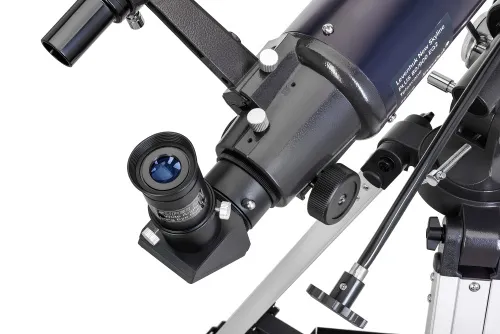
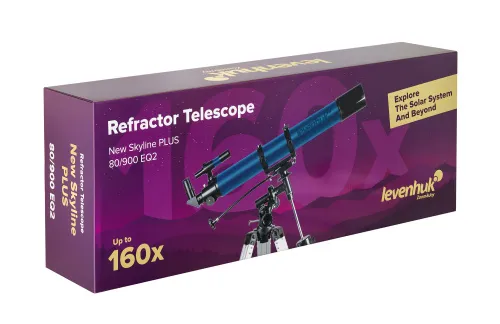
Classic telescope for observing the Moon, planets of the Solar System, and bright deep-sky objects
| Product ID | 86209 |
| Brand | Levenhuk, Inc., USA |
| Warranty | 50 years |
| EAN | 5905555027029 |
| Package size (LxWxH) | 44.9x17.3x9.1 in |
| Shipping Weight | 31.5 lb |
The Levenhuk New Skyline PLUS 80/900 EQ2 is your ticket to your first astronomical discoveries. Its main advantage is a full set of optical accessories. You can start exploring space right out of the box. Unpack and assemble the telescope. Choose a convenient spot for observation, such as a balcony, garden, or forest clearing. Then, you are ready to go!
What can you see?
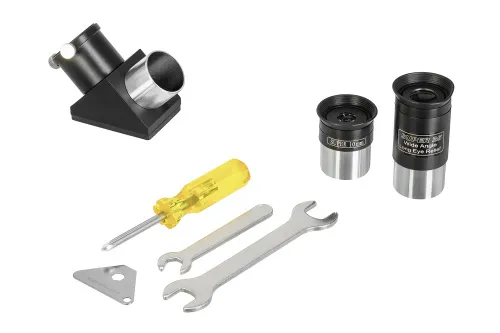
The level of detail depends on the eyepiece you use. The kit includes two eyepieces: SUPER 25mm and 10mm. They have magnifications of 36x and 90x.
At 36x, the Moon looks like a map from an astronomy atlas. It fits entirely into the field of view. You can find and recognize the largest craters of the Moon (Tycho, Copernicus, Kepler, Aristarchus, and Plato) and the basalt seas (Ocean of Storms, Sea of Rains, and Sea of Crises). Jupiter shows its disk with two equatorial belts and four Galilean moons stretching out beside it. Saturn appears with its rings clearly separated from the disk — small but unmistakable. Deep space is also within reach. The Pleiades cluster looks like a scattering of blue stars on black velvet. The Andromeda Galaxy reveals its core as an elongated smudge surrounded by a faint oval halo.
At 90x, you get a more detailed view of space. The Moon comes even closer. You can see terraces, mountain ranges, chains of smaller craters, and rilles in the seas. On Jupiter’s disk, the North and South Equatorial Belts are clearly visible. Saturn’s rings show distinct separation from the planet, and right next to it, you can spot Titan, which is its largest moon. Some globular clusters, like M13 in Hercules and M5 in Serpens, begin to resolve into individual stars at their edges — a truly breathtaking spectacle.
**What’s in the box
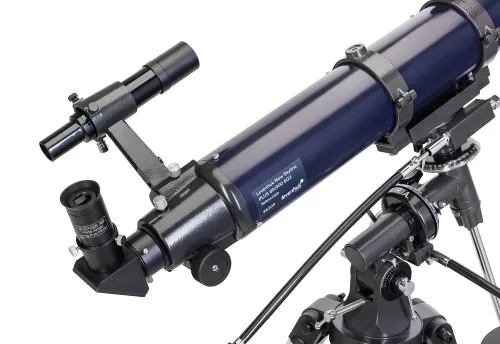
Besides the two eyepieces, the telescope comes with a 6x30 optical finder and a 90° diagonal mirror. The finderscope helps you quickly locate any object in the sky in just 10 to 20 seconds. The diagonal mirror makes observing comfortable and natural for your back and neck.
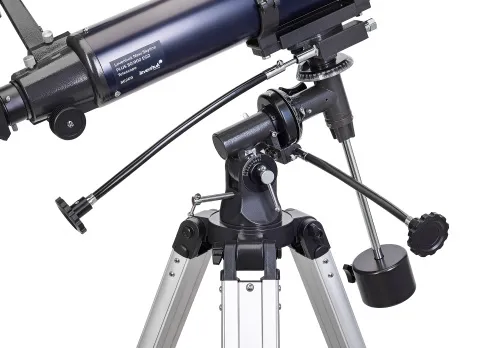
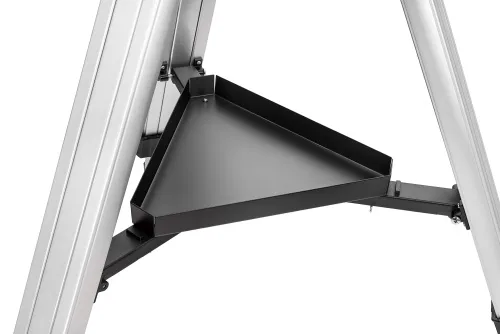
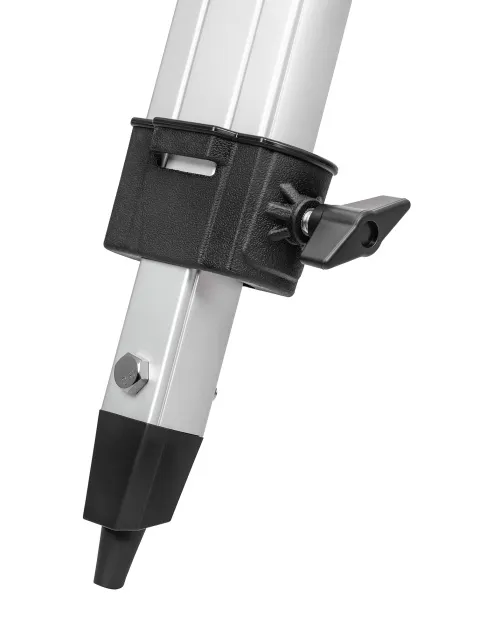
The optical tube sits on an EQ2 equatorial mount with manual control. The mount provides a stable image with no vibrations. It also compensates for the Earth’s daily rotation, so objects don’t drift out of view. A sturdy aluminum tripod completes the setup. It has a convenient accessory tray, so everything you need stays within reach.
Key features:
- Classic telescope for comprehensive night sky exploration; great for getting to know the Moon, the Solar System, and the beauties of bright deep space
- Full kit: optical accessories, EQ mount, and a sturdy tripod for observing right after unboxing
- Long focal length (900 mm) provides high magnification even with the standard 10mm eyepiece. You can immediately move on to the most interesting objects.
- The Moon and planets remain clearly visible even under city lights, making balcony observations a truly rewarding experience.
- The EQ mount compensates for the Earth’s rotation and keeps your target in the frame.
- Locate any celestial body in a mere 10 or 20 seconds thanks to the 6x30 optical finderscope.
The kit includes:
- Telescope optical tube
- Equatorial mount EQ2
- SUPER eyepiece 10mm, 1.25"
- SUPER eyepiece 25mm, 1.25"
- 6x30 optical finderscope
- 90° diagonal mirror
- Slow-motion controls
- Counterweight
- Counterweight bar
- Tube rings
- Aluminum tripod
- Accessory tray
- User manual and warranty card
| Product ID | 86209 |
| Brand | Levenhuk, Inc., USA |
| Warranty | 50 years |
| EAN | 5905555027029 |
| Package size (LxWxH) | 44.9x17.3x9.1 in |
| Shipping Weight | 31.5 lb |
| Optical design | reflector |
| Optical scheme | achromat |
| Optics material | optical glass |
| Optics coating | fully multi-coated |
| Objective lens diameter (aperture), in | 3.1 |
| Focal length, in | 35.4 |
| Highest practical power, x | 160 |
| Aperture ratio | f/11.3 |
| Resolution threshold, arcseconds | 1.45 |
| Limiting stellar magnitude | 12 |
| Eyepieces | SUPER 10mm (90x), SUPER 25mm (36x) |
| Eyepiece barrel diameter, in | 1.25 |
| Finderscope | optical, 6x30 |
| Focuser | 1.25", rack & pinion |
| Tripod | aluminum |
| Tripod height (adjustable), in | 27.6–51.6 |
| Accessory tray | ✓ |
| Telescope control | manual |
| Mount | equatorial, EQ2 |
| Slow-motion controls | 2 slow-motion control knobs |
| Counterweights | yes |
| Additional | standard T-thread (M42) for mounting a SLR camera |
| Optical tube mounting mode | attachment rings (included) |
| Optical tube material | aluminum |
| User level | beginners, experienced users |
| Assembly and installation difficulty level | easy |
| Observed object | planets of the Solar System, terrestrial objects |
Convenient diagrams that describe how to install additional accessories on refractors and catadioptric telescopes
Find out how to assemble a telescope on an example of the Levenhuk Skyline 90x900 EQ telescope
This short guide will help you avoid typical mistakes and learn more about telescope and mounting types
The basics of astronomical observations for beginners
In this article we have gathered answers to some of the most frequently asked questions about telescopes
The most interesting celestial objects you can observe with Levenhuk telescopes
How telescopes work?
You can actually perform observations from your balcony!
All about telescope sizes, types, magnification, and mounts
Learn how to set up and use the telescope properly
Astronomy in light-polluted skies. Find out what you can observe in the city
Read an interesting comprehensive article on telescopes for little astronomers
The pictures are made with Levenhuk telescopes
Celestial objects you can observe with telescopes of different apertures
Colored and vivid images of galaxies, planets and star clusters entrance everyone who is fascinated by boundless space
Find an interesting review on the history of the changes to a refracting telescope
To make the process of choosing a telescope easier, we will tell you about the characteristics of the most popular types of telescopes today
Learn everything you need to know about refractor telescopes to make the right choice